Published quarterly under the RBI Liquidity Risk Management Framework for Non-Banking Financial Companies. Select a financial year and quarter below.
Policies and Public Disclosure on liquidity risk for the quarter ending June 30, 2023
Background
RBI has issued final guidelines on Liquidity Risk Management Framework for Non-Banking Financial Companies and Core Investment Companies on November 04, 2019 vide circular RBI/2019-20/88 DOR.NBFC (PD) CC.No.102/03.10.001/201920. As per the said guidelines, NBFC are required to publicly disclose the below information related to liquidity risk on a quarterly basis.
Accordingly, the disclosures on liquidity risk as at June 30, 2023 are as under:
(I) Funding Concentration based on significant counterparty (both deposit and borrowings)
| No. of Significant Counterparties | Amount (INR in Lakhs) | % of Total Deposit | % of Total Liabilities* |
|---|---|---|---|
| 0 | 0 | Not applicable | 0.00% |
(II) Top 20 large deposits: Not Applicable
(III) Top 10 borrowings: (amount in Rupees and % of total borrowings):
| Amount (INR in Lakhs) | % of Total Borrowing |
|---|---|
| 0.00 | 0.00% |
(IV) Funding concentration based on significant instrument / product:
| Name of the Instrument | Outstanding as on June 30, 2023 (INR in Lakhs) | % of Total Liabilities* |
|---|---|---|
| Term Loan-Banks | 0.00 | 0.00% |
| Term Loan-NBFC | 0.00 | 0.00% |
| Non - Convertible Debentures | 0.00 | 0.00% |
(V) Stock Ratios:
| Particulars | as a % of total public funds* | as a % of total liabilities* | as a % of total assets |
|---|---|---|---|
| Commercial Papers | NA | 0.00% | 0.00% |
| Non-convertible debentures (original maturity of less than one year) | NA | 0.00% | 0.00% |
| Other short-term liabilities | NA | 100.00% | 1.20% |
* Total liability excludes net worth of the Company
Institutional set-up for liquidity risk management:
The Board of Directors of the Company has an overall responsibility and oversight for the management of all the risks, including liquidity risk, to which the Company is exposed to in the course of conducting its business. The Board approves the governance structure, policies, strategy and the risk limits for the management of liquidity risk. The Board of Directors approved the constitution of the Risk Management Committee (RMC) for the effective supervision, evaluation, monitoring and review of various aspects and types of risks, including liquidity risk, faced by the Company. The meetings of RMC (Board) are held at quarterly intervals and more frequently as warranted from time to time. Further, the Board of Directors also approved the constitution of the Asset Liability Committee (ALCO), which functions as the strategic decision-making body for the asset-liability management of the Company from risk return perspective and within the risk appetite approved by the Board. The main objective of ALCO is to assist the Board and RMC in effective discharge of the responsibilities of asset-liability management, market risk management, liquidity and interest rate risk management and also to ensure adherence to risk tolerance/limits set up by the Board. ALCO provides guidance and directions in terms of interest rate, liquidity, funding sources, and investment of surplus funds.
Policies and Public Disclosure on liquidity risk for the quarter ending September 30, 2023
Background
RBI has issued final guidelines on Liquidity Risk Management Framework for Non-Banking Financial Companies and Core Investment Companies on November 04, 2019 vide circular RBI/2019-20/88 DOR.NBFC (PD) CC.No.102/03.10.001/201920. As per the said guidelines, NBFC are required to publicly disclose the below information related to liquidity risk on a quarterly basis.
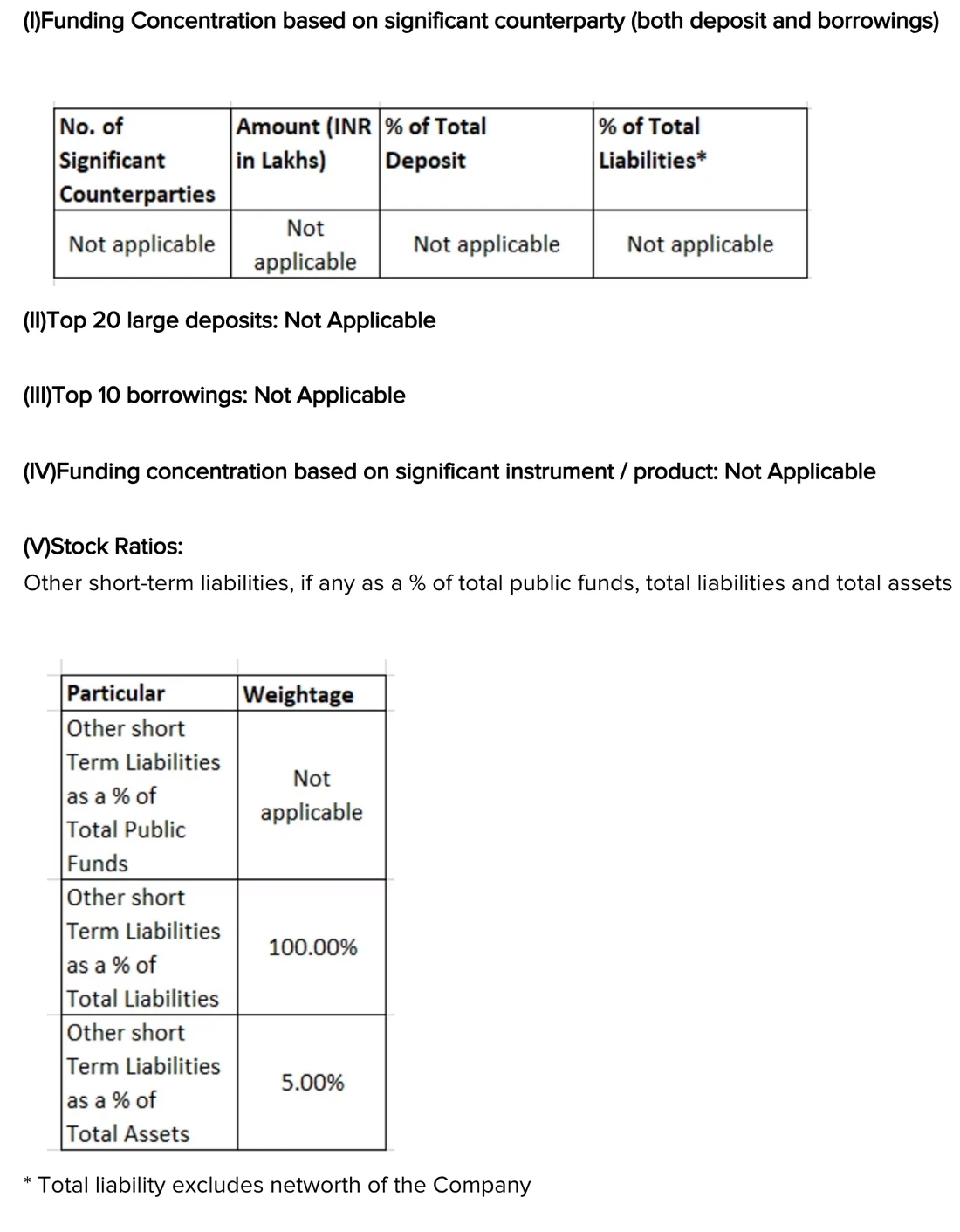
Accordingly, the disclosures on liquidity risk as at September 30, 2023 are as under:
Institutional set-up for liquidity risk management:
The Board of Directors of the Company has an overall responsibility and oversight for the management of all the risks, including liquidity risk, to which the Company is exposed to in the course of conducting its business. The Board approves the governance structure, policies, strategy and the risk limits for the management of liquidity risk. The Board of Directors approved the constitution of the Risk Management Committee (RMC) for the effective supervision, evaluation, monitoring and review of various aspects and types ofrisks, including liquidity risk, faced by the Company. The meetings of RMC (Board) are held at quarterly interval and more frequently as warranted from time to time. Further, the Board of Directors also approves constitution of Asset Liability Committee (ALCO), which functions as the strategic decision-making body for the asset-liability management of the Company from risk return perspective and within the risk appetite approved by the Board. The main objective of ALCO is to assist the Board and RMC in effective discharge of the responsibilities of asset-liability management, market risk management, liquidity and interest rate risk management and also to ensure adherence to risk tolerance/limits set up by the Board. ALCO provides guidance and directions in terms of interest rate, liquidity, funding sources, and investment of surplus funds
Policies and Public Disclosure on liquidity risk for the quarter ending December 31, 2023
Background
RBI has issued final guidelines on Liquidity Risk Management Framework for Non-Banking Financial Companies and Core Investment Companies on November 04, 2019 vide circular RBI/2019-20/88 DOR.NBFC (PD) CC.No.102/03.10.001/201920. As per the said guidelines, NBFC are required to publicly disclose the below information related to liquidity risk on a quarterly basis.
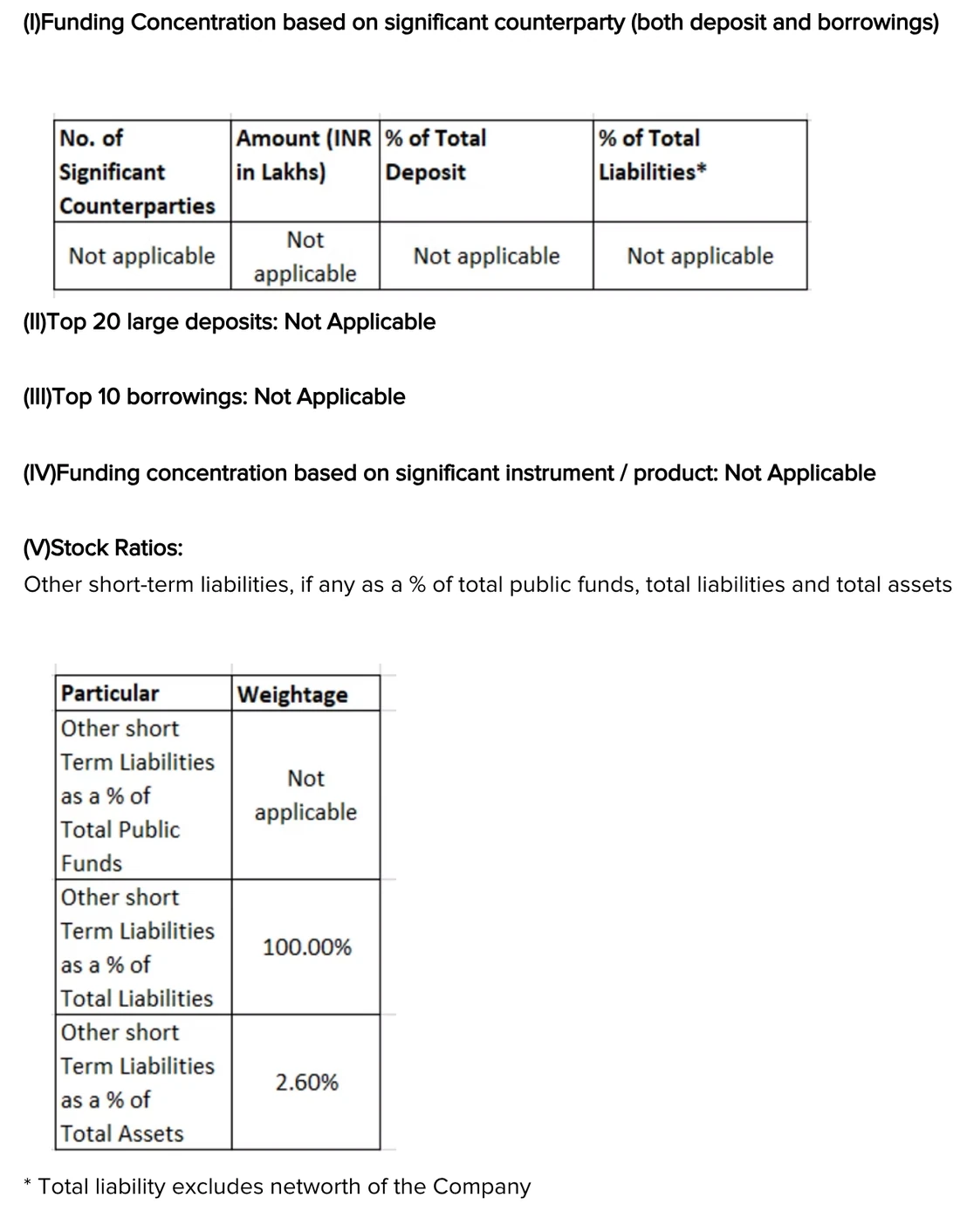
Accordingly, the disclosures on liquidity risk as at Dec 31, 2023 are as under:
Institutional set-up for liquidity risk management:
The Board of Directors of the Company has an overall responsibility and oversight for the management of all the risks, including liquidity risk, to which the Company is exposed to in the course of conducting its business. The Board approves the governance structure, policies, strategy and the risk limits for the management of liquidity risk. The Board of Directors approved the constitution of the Risk Management Committee (RMC) for the effective supervision, evaluation, monitoring and review of various aspects and types ofrisks, including liquidity risk, faced by the Company. The meetings of RMC (Board) are held at quarterly interval and more frequently as warranted from time to time. Further, the Board of Directors also approves constitution of Asset Liability Committee (ALCO), which functions as the strategic decision-making body for the asset-liability management of the Company from risk return perspective and within the risk appetite approved by the Board. The main objective of ALCO is to assist the Board and RMC in effective discharge of the responsibilities of asset-liability management, market risk management, liquidity and interest rate risk management and also to ensure adherence to risk tolerance/limits set up by the Board. ALCO provides guidance and directions in terms of interest rate, liquidity, funding sources, and investment of surplus funds.
Policies and Public Disclosure on liquidity risk for the quarter ending March 31, 2024
Background
RBI has issued final guidelines on Liquidity Risk Management Framework for Non-Banking Financial Companies and Core Investment Companies on November 04, 2019 vide circular RBI/2019-20/88 DOR.NBFC (PD) CC.No.102/03.10.001/201920. As per the said guidelines, NBFC are required to publicly disclose the below information related to liquidity risk on a quarterly basis.
Accordingly, the disclosures on liquidity risk as at March 31, 2024 are as under:
(I) Funding Concentration based on significant counterparty (both deposit and borrowings)
| No. of Significant Counterparties | Amount (INR in Lakhs) | % of Total Deposit | % of Total Liabilities* |
|---|---|---|---|
| Not applicable | Not applicable | Not applicable | Not applicable |
(II) Top 20 large deposits: Not Applicable
(III) Top 10 borrowings: Not Applicable
(IV) Funding concentration based on significant instrument / product: Not Applicable
(V) Stock Ratios:
Other short-term liabilities, if any as a % of total public funds, total liabilities and total assets
| Particular | Weightage |
|---|---|
| Other short Term Liabilities as a % of Total Public Funds | Not applicable |
| Other short Term Liabilities as a % of Total Liabilities | 100.00% |
| Other short Term Liabilities as a % of Total Assets | 3.41% |
* Total liability excludes networth of the Company
Institutional set-up for liquidity risk management:
The Board of Directors of the Company has an overall responsibility and oversight for the management of all the risks, including liquidity risk, to which the Company is exposed to in the course of conducting its business. The Board approves the governance structure, policies, strategy and the risk limits for the management of liquidity risk. The Board of Directors approved the constitution of the Risk Management Committee (RMC) for the effective supervision, evaluation, monitoring and review of various aspects and types ofrisks, including liquidity risk, faced by the Company. The meetings of RMC (Board) are held at quarterly interval and more frequently as warranted from time to time. Further, the Board of Directors also approves constitution of Asset Liability Committee (ALCO), which functions as the strategic decision-making body for the asset-liability management of the Company from risk return perspective and within the risk appetite approved by the Board. The main objective of ALCO is to assist the Board and RMC in effective discharge of the responsibilities of asset-liability management, market risk management, liquidity and interest rate risk management and also to ensure adherence to risk tolerance/limits set up by the Board. ALCO provides guidance and directions in terms of interest rate, liquidity, funding sources, and investment of surplus funds.
Policies and Public Disclosure on liquidity risk for the quarter ending June 30, 2024
Background
RBI has issued final guidelines on Liquidity Risk Management Framework for Non-Banking Financial Companies and Core Investment Companies on November 04, 2019 vide circular RBI/2019-20/88 DOR.NBFC (PD) CC.No.102/03.10.001/201920. As per the said guidelines, NBFC are required to publicly disclose the below information related to liquidity risk on a quarterly basis.
Accordingly, the disclosures on liquidity risk as at June 30, 2024 are as under:
(I) Funding Concentration based on significant counterparty (both deposit and borrowings)
| No. of Significant Counterparties | Amount (INR in Lakhs) | % of Total Deposit | % of Total Liabilities* |
|---|---|---|---|
| Not applicable | Not applicable | Not applicable | Not applicable |
(II) Top 20 large deposits: Not Applicable
(III) Top 10 borrowings: Not Applicable
(IV) Funding concentration based on significant instrument / product: Not Applicable
(V) Stock Ratios:
Other short-term liabilities, if any as a % of total public funds, total liabilities and total assets
| Particular | Weightage |
|---|---|
| Other short Term Liabilities as a % of Total Public Funds | Not applicable |
| Other short Term Liabilities as a % of Total Liabilities | 100.00% |
| Other short Term Liabilities as a % of Total Assets | 29.44% |
* Total liability excludes networth of the Company
Institutional set-up for liquidity risk management:
The Board of Directors of the Company has an overall responsibility and oversight for the management of all the risks, including liquidity risk, to which the Company is exposed to in the course of conducting its business. The Board approves the governance structure, policies, strategy and the risk limits for the management of liquidity risk. The Board of Directors approved the constitution of the Risk Management Committee (RMC) for the effective supervision, evaluation, monitoring and review of various aspects and types ofrisks, including liquidity risk, faced by the Company. The meetings of RMC (Board) are held at quarterly interval and more frequently as warranted from time to time. Further, the Board of Directors also approves constitution of Asset Liability Committee (ALCO), which functions as the strategic decision-making body for the asset-liability management of the Company from risk return perspective and within the risk appetite approved by the Board. The main objective of ALCO is to assist the Board and RMC in effective discharge of the responsibilities of asset-liability management, market risk management, liquidity and interest rate risk management and also to ensure adherence to risk tolerance/limits set up by the Board. ALCO provides guidance and directions in terms of interest rate, liquidity, funding sources, and investment of surplus funds.
Policies and Public Disclosure on liquidity risk for the quarter ending September 30, 2024
Background
RBI has issued final guidelines on Liquidity Risk Management Framework for Non-Banking Financial Companies and Core Investment Companies on November 04, 2019 vide circular RBI/2019-20/88 DOR.NBFC (PD) CC.No.102/03.10.001/201920. As per the said guidelines, NBFC are required to publicly disclose the below information related to liquidity risk on a quarterly basis.
Accordingly, the disclosures on liquidity risk as at September 30, 2024 are as under:
(I) Funding Concentration based on significant counterparty (both deposit and borrowings)
| No. of Significant Counterparties | Amount (INR in Lakhs) | % of Total Deposit | % of Total Liabilities* |
|---|---|---|---|
| Not applicable | Not applicable | Not applicable | Not applicable |
(II) Top 20 large deposits: Not Applicable
(III) Top 10 borrowings: Not Applicable
(IV) Funding concentration based on significant instrument / product: Not Applicable
(V) Stock Ratios:
Other short-term liabilities, if any as a % of total public funds, total liabilities and total assets
| Particular | Weightage |
|---|---|
| Other short Term Liabilities as a % of Total Public Funds | Not applicable |
| Other short Term Liabilities as a % of Total Liabilities | 100.00% |
| Other short Term Liabilities as a % of Total Assets | 29.10% |
* Total liability excludes networth of the Company
Institutional set-up for liquidity risk management:
The Board of Directors of the Company has an overall responsibility and oversight for the management of all the risks, including liquidity risk, to which the Company is exposed to in the course of conducting its business. The Board approves the governance structure, policies, strategy and the risk limits for the management of liquidity risk. The Board of Directors approved the constitution of the Risk Management Committee (RMC) for the effective supervision, evaluation, monitoring and review of various aspects and types ofrisks, including liquidity risk, faced by the Company. The meetings of RMC (Board) are held at quarterly interval and more frequently as warranted from time to time. Further, the Board of Directors also approves constitution of Asset Liability Committee (ALCO), which functions as the strategic decision-making body for the asset-liability management of the Company from risk return perspective and within the risk appetite approved by the Board. The main objective of ALCO is to assist the Board and RMC in effective discharge of the responsibilities of asset-liability management, market risk management, liquidity and interest rate risk management and also to ensure adherence to risk tolerance/limits set up by the Board. ALCO provides guidance and directions in terms of interest rate, liquidity, funding sources, and investment of surplus funds.
Policies and Public Disclosure on liquidity risk for the quarter ending December 31, 2024
Background
RBI has issued final guidelines on Liquidity Risk Management Framework for Non-Banking Financial Companies and Core Investment Companies on November 04, 2019 vide circular RBI/2019-20/88 DOR.NBFC (PD) CC.No.102/03.10.001/201920. As per the said guidelines, NBFC are required to publicly disclose the below information related to liquidity risk on a quarterly basis.
Accordingly, the disclosures on liquidity risk as at December 31, 2024 are as under:
(I) Funding Concentration based on significant counterparty (both deposit and borrowings)
| No. of Significant Counterparties | Amount (INR in Lakhs) | % of Total Deposit | % of Total Liabilities* |
|---|---|---|---|
| Not applicable | Not applicable | Not applicable | Not applicable |
(II) Top 20 large deposits: Not Applicable
(III) Top 10 borrowings: Not Applicable
(IV) Funding concentration based on significant instrument / product: Not Applicable
(V) Stock Ratios:
Other short-term liabilities, if any as a % of total public funds, total liabilities and total assets
| Particular | Weightage |
|---|---|
| Other short Term Liabilities as a % of Total Public Funds | Not applicable |
| Other short Term Liabilities as a % of Total Liabilities | 100.00% |
| Other short Term Liabilities as a % of Total Assets | 28.36% |
* Total liability excludes net worth of the Company
Institutional set-up for liquidity risk management:
The Board of Directors of the Company has an overall responsibility and oversight for the management of all the risks, including liquidity risk, to which the Company is exposed to in the course of conducting its business. The Board approves the governance structure, policies, strategy and the risk limits for the management of liquidity risk. The Board of Directors approved the constitution of the Risk Management Committee (RMC) for the effective supervision, evaluation, monitoring and review of various aspects and types ofrisks, including liquidity risk, faced by the Company. The meetings of RMC (Board) are held at quarterly interval and more frequently as warranted from time to time. Further, the Board of Directors also approves constitution of Asset Liability Committee (ALCO), which functions as the strategic decision-making body for the asset-liability management of the Company from risk return perspective and within the risk appetite approved by the Board. The main objective of ALCO is to assist the Board and RMC in effective discharge of the responsibilities of asset-liability management, market risk management, liquidity and interest rate risk management and also to ensure adherence to risk tolerance/limits set up by the Board. ALCO provides guidance and directions in terms of interest rate, liquidity, funding sources, and investment of surplus funds.
Policies and Public Disclosure on liquidity risk for the quarter ending March 31, 2025
Background
RBI has issued final guidelines on Liquidity Risk Management Framework for Non-Banking Financial Companies and Core Investment Companies on November 04, 2019 vide circular RBI/2019-20/88 DOR.NBFC (PD) CC.No.102/03.10.001/201920. As per the said guidelines, NBFC are required to publicly disclose the below information related to liquidity risk on a quarterly basis.
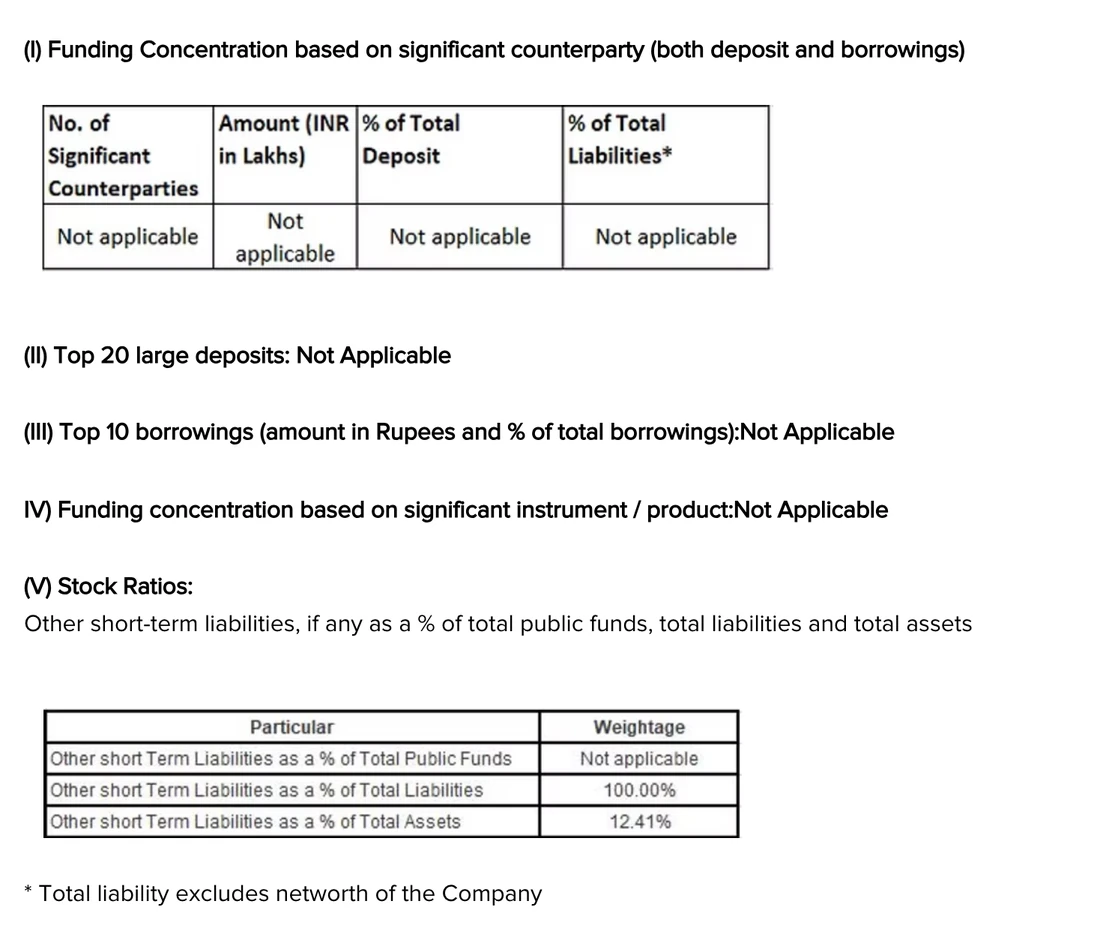
Accordingly, the disclosures on liquidity risk as at March 31, 2025 are as under:
Institutional set-up for liquidity risk management:
The Board of Directors of the Company has an overall responsibility and oversight for the management of all the risks, including liquidity risk, to which the Company is exposed to in the course of conducting its business. The Board approves the governance structure, policies, strategy and the risk limits for the management of liquidity risk. The Board of Directors approved the constitution of the Risk Management Committee (RMC) for the effective supervision, evaluation, monitoring and review of various aspects and types ofrisks, including liquidity risk, faced by the Company. The meetings of RMC (Board) are held at quarterly interval and more frequently as warranted from time to time. Further, the Board of Directors also approves constitution of Asset Liability Committee (ALCO), which functions as the strategic decision-making body for the asset-liability management of the Company from risk return perspective and within the risk appetite approved by the Board. The main objective of ALCO is to assist the Board and RMC in effective discharge of the responsibilities of asset-liability management, market risk management, liquidity and interest rate risk management and also to ensure adherence to risk tolerance/limits set up by the Board. ALCO provides guidance and directions in terms of interest rate, liquidity, funding sources, and investment of surplus funds.
Policies and Public Disclosure on liquidity risk for the quarter ending June 30, 2025
Background
RBI has issued final guidelines on Liquidity Risk Management Framework for Non-Banking Financial Companies and Core Investment Companies on November 04, 2019 vide circular RBI/2019-20/88 DOR.NBFC (PD) CC.No.102/03.10.001/201920. As per the said guidelines, NBFC are required to publicly disclose the below information related to liquidity risk on a quarterly basis.
Accordingly, the disclosures on liquidity risk as at June 30, 2025 are as under:
(I) Funding Concentration based on significant counterparty (both deposit and borrowings)
| No. of Significant Counterparties | Amount (INR in Lakhs) | % of Total Deposit | % of Total Liabilities* |
|---|---|---|---|
| Not applicable | Not applicable | Not applicable | Not applicable |
(II) Top 20 large deposits: Not Applicable
(III) Top 10 borrowings: Not Applicable
(IV) Funding concentration based on significant instrument / product: Not Applicable
(V) Stock Ratios:
Other short-term liabilities, if any as a % of total public funds, total liabilities and total assets
| Particulars | Weightage |
|---|---|
| Other short Term Liabilities as a % of Total Public Funds | Not Applicable |
| Other short Term Liabilities as a % of Total Liabilities | 100.00% |
| Other short Term Liabilities as a % of Total Assets | 9.36% |
* Total liability excludes networth of the Company
Institutional set-up for liquidity risk management:
The Board of Directors of the Company has an overall responsibility and oversight for the management of all the risks, including liquidity risk, to which the Company is exposed to in the course of conducting its business. The Board approves the governance structure, policies, strategy and the risk limits for the management of liquidity risk. The Board of Directors approved the constitution of the Risk Management Committee (RMC) for the effective supervision, evaluation, monitoring and review of various aspects and types ofrisks, including liquidity risk, faced by the Company. The meetings of RMC (Board) are held at quarterly interval and more frequently as warranted from time to time. Further, the Board of Directors also approves constitution of Asset Liability Committee (ALCO), which functions as the strategic decision-making body for the asset-liability management of the Company from risk return perspective and within the risk appetite approved by the Board. The main objective of ALCO is to assist the Board and RMC in effective discharge of the responsibilities of asset-liability management, market risk management, liquidity and interest rate risk management and also to ensure adherence to risk tolerance/limits set up by the Board. ALCO provides guidance and directions in terms of interest rate, liquidity, funding sources, and investment of surplus funds.
Policies and Public Disclosure on liquidity risk for the quarter ending September 30, 2025
Background
RBI has issued final guidelines on Liquidity Risk Management Framework for Non-Banking Financial Companies and Core Investment Companies on November 04, 2019 vide circular RBI/2019-20/88 DOR.NBFC (PD) CC.No.102/03.10.001/201920. As per the said guidelines, NBFC are required to publicly disclose the below information related to liquidity risk on a quarterly basis.
Accordingly, the disclosures on liquidity risk as at September 30, 2025 are as under:
(I) Funding Concentration based on significant counterparty (both deposit and borrowings)
| No. of Significant Counterparties | Amount (INR in Lakhs) | % of Total Deposit | % of Total Liabilities* |
|---|---|---|---|
| Not applicable | Not applicable | Not applicable | Not applicable |
(II) Top 20 large deposits: Not Applicable
(III) Top 10 borrowings: Not Applicable
(IV) Funding concentration based on significant instrument / product: Not Applicable
(V) Stock Ratios:
Other short-term liabilities, if any as a % of total public funds, total liabilities and total assets
| Particular | Weightage |
|---|---|
| Other short Term Liabilities as a % of Total Public Funds | Not applicable |
| Other short Term Liabilities as a % of Total Liabilities | 100.00% |
| Other short Term Liabilities as a % of Total Assets | 0.27% |
* Total liability excludes net worth of the Company
Institutional set-up for liquidity risk management:
The Board of Directors of the Company has an overall responsibility and oversight for the management of all the risks, including liquidity risk, to which the Company is exposed to in the course of conducting its business. The Board approves the governance structure, policies, strategy and the risk limits for the management of liquidity risk. The Board of Directors approved the constitution of the Risk Management Committee (RMC) for the effective supervision, evaluation, monitoring and review of various aspects and types of risks, including liquidity risk, faced by the Company. The meetings of RMC (Board) are held at quarterly interval and more frequently as warranted from time to time. Further, the Board of Directors also approved constitution of Asset Liability Committee (ALCO), which functions as the strategic decision-making body for the asset-liability management of the Company from risk return perspective and within the risk appetite approved by the Board. The main objective of ALCO is to assist the Board and RMC in effective discharge of the responsibilities of asset-liability management, market risk management, liquidity and interest rate risk management and also to ensure adherence to risk tolerance/limits set up by the Board. ALCO provides guidance and directions in terms of interest rate, liquidity, funding sources, and investment of surplus funds.
Policies and Public Disclosure on liquidity risk for the quarter ending December 31, 2025
Background
RBI has issued final guidelines on Liquidity Risk Management Framework for Non-Banking Financial Companies and Core Investment Companies on November 04, 2019 vide circular RBI/2019-20/88 DOR.NBFC (PD) CC.No.102/03.10.001/201920. As per the said guidelines, NBFC are required to publicly disclose the below information related to liquidity risk on a quarterly basis.
Accordingly, the disclosures on liquidity risk as at December 31, 2025 are as under:
(I) Funding Concentration based on significant counterparty (both deposit and borrowings)
| No. of Significant Counterparties | Amount (INR in Lakhs) | % of Total Deposit | % of Total Liabilities* |
|---|---|---|---|
| Not applicable | Not applicable | Not applicable | Not applicable |
(II) Top 20 large deposits: Not Applicable
(III) Top 10 borrowings: Not Applicable
(IV) Funding concentration based on significant instrument / product: Not Applicable
(V) Stock Ratios:
Other short-term liabilities, if any as a % of total public funds, total liabilities and total assets
| Particular | Weightage |
|---|---|
| Other short Term Liabilities as a % of Total Public Funds | Not applicable |
| Other short Term Liabilities as a % of Total Liabilities | 100.00% |
| Other short Term Liabilities as a % of Total Assets | 2.93% |
* Total liability excludes net worth of the Company
Institutional set-up for liquidity risk management:
The Board of Directors of the Company has an overall responsibility and oversight for the management of all the risks, including liquidity risk, to which the Company is exposed to in the course of conducting its business. The Board approves the governance structure, policies, strategy and the risk limits for the management of liquidity risk. The Board of Directors approved the constitution of the Risk Management Committee (RMC) for the effective supervision, evaluation, monitoring and review of various aspects and types of risks, including liquidity risk, faced by the Company. The meetings of RMC (Board) are held at quarterly interval and more frequently as warranted from time to time. Further, the Board of Directors also approved constitution of Asset Liability Committee (ALCO), which functions as the strategic decision-making body for the asset-liability management of the Company from risk return perspective and within the risk appetite approved by the Board. The main objective of ALCO is to assist the Board and RMC in effective discharge of the responsibilities of asset-liability management, market risk management, liquidity and interest rate risk management and also to ensure adherence to risk tolerance/limits set up by the Board. ALCO provides guidance and directions in terms of interest rate, liquidity, funding sources, and investment of surplus funds.
Policies and Public Disclosure on liquidity risk for the quarter ending March 31, 2026
Background
RBI has issued final guidelines on Liquidity Risk Management Framework for Non-Banking Financial Companies and Core Investment Companies on November 04, 2019 vide circular RBI/2019-20/88 DOR.NBFC (PD) CC.No.102/03.10.001/201920. As per the said guidelines, NBFC are required to publicly disclose the below information related to liquidity risk on a quarterly basis.
Accordingly, the disclosures on liquidity risk as at March 31, 2026 are as under:
(I) Funding Concentration based on significant counterparty (both deposit and borrowings)
| No. of Significant Counterparties | Amount (INR in Lakhs) | % of Total Deposit | % of Total Liabilities* |
|---|---|---|---|
| 0 | 0 | Not applicable | 0.00% |
(II) Top 20 large deposits: Not Applicable
(III) Top 10 borrowings (amount in Rupees and % of total borrowings):
| Amount (INR in Lakhs) | % of Total borrowing |
|---|---|
| 0.00 | 0.00% |
(IV) Funding concentration based on significant instrument / product:
(V) Stock Ratios:
* Total liability excludes net worth of the Company
Institutional set-up for liquidity risk management:
The Board of Directors of the Company has an overall responsibility and oversight for the management of all the risks, including liquidity risk, to which the Company is exposed to in the course of conducting its business. The Board approves the governance structure, policies, strategy and the risk limits for the management of liquidity risk. The Board of Directors approved the constitution of the Risk Management Committee (RMC) for the effective supervision, evaluation, monitoring and review of various aspects and types of risks, including liquidity risk, faced by the Company. The meetings of RMC (Board) are held at quarterly intervals and more frequently as warranted from time to time. Further, the Board of Directors also approved the constitution of the Asset Liability Committee (ALCO), which functions as the strategic decision-making body for the asset-liability management of the Company from risk return perspective and within the risk appetite approved by the Board. The main objective of ALCO is to assist the Board and RMC in effective discharge of the responsibilities of asset-liability management, market risk management, liquidity and interest rate risk management and also to ensure adherence to risk tolerance/limits set up by the Board. ALCO provides guidance and directions in terms of interest rate, liquidity, funding sources, and investment of surplus funds.
Public Disclosure on liquidity risk for the quarter ending June 30, 2026
RBI has issued final guidelines on Liquidity Risk Management Framework for Non-Banking Financial Companies and Core Investment Companies on November 04, 2019 vide circular RBI/2019-20/88 DOR.NBFC (PD) CC.No.102/03.10.001/201920. As per the said guidelines, NBFC are required to publicly disclose the below information related to liquidity risk on a quarterly basis.
Accordingly, the disclosures on liquidity risk as at June 30, 2026 are as under:
(I) Funding Concentration based on significant counterparty (both deposit and borrowings)
| No. of Significant Counterparties | Amount (INR in Lakhs) | % of Total Deposit | % of Total Liabilities* |
|---|---|---|---|
| 0 | 0 | Not applicable | 0.00% |
(II) Top 20 large deposits: Not Applicable
(III) Top 10 borrowings (amount in Rupees and % of total borrowings):
| Amount (INR in Lakhs) | % of Total Borrowing |
|---|---|
| 0.00 | 0.00% |
(IV) Funding concentration based on significant instrument / product:
| Name of the Instrument | Outstanding as on June 30, 2026 (INR in Lakhs) | % of Total Liabilities* |
|---|---|---|
| Term Loan-Banks | 0.00 | 0.00% |
| Term Loan-NBFC | 0.00 | 0.00% |
| Non - Convertible Debentures | 0.00 | 0.00% |
(V) Stock Ratios:
| Particulars | as a % of total public funds* | as a % of total liabilities* | as a % of total assets |
|---|---|---|---|
| Commercial Papers | NA | 0.00% | 0.00% |
| Non-convertible debentures (original maturity of less than one year) | NA | 0.00% | 0.00% |
| Other short-term liabilities | NA | 100.00% | 1.47% |
* Total liability excludes net worth of the Company
Institutional set-up for liquidity risk management:
The Board of Directors of the Company has an overall responsibility and oversight for the management of all the risks, including liquidity risk, to which the Company is exposed to in the course of conducting its business. The Board approves the governance structure, policies, strategy and the risk limits for the management of liquidity risk. The Board of Directors approved the constitution of the Risk Management Committee (RMC) for the effective supervision, evaluation, monitoring and review of various aspects and types of risks, including liquidity risk, faced by the Company. The meetings of RMC (Board) are held at quarterly intervals and more frequently as warranted from time to time. Further, the Board of Directors also approved the constitution of the Asset Liability Committee (ALCO), which functions as the strategic decision-making body for the asset-liability management of the Company from risk return perspective and within the risk appetite approved by the Board. The main objective of ALCO is to assist the Board and RMC in effective discharge of the responsibilities of asset-liability management, market risk management, liquidity and interest rate risk management and also to ensure adherence to risk tolerance/limits set up by the Board. ALCO provides guidance and directions in terms of interest rate, liquidity, funding sources, and investment of surplus funds.
Avanti Microfinance Private Limited is a Non-Banking Financial Company registered with the Reserve Bank of India. CIN: U65929KA2016PTC138292. Registered Address: # 2727, 2nd Floor, 1st Main Road, HAL 3rd Stage, Ward No. 58, New Thippasandra, Bangalore North, Bangalore, Karnataka, India, 560075.